Generate reports from an archived database
Add an archived UserLock database and generate reports from it, alongside your production database.
You can add any existing UserLock database other than the production database, for example a former database kept after a database migration. Databases created with earlier versions of UserLock are supported.
Before you add it, make sure that:
The UserLock server can reach the database. The connection is made from the server, not from the console. For a database file, such as a SQLite or Microsoft Access database, the path must be valid on the UserLock server.
You have the connection details of the database.
For all the rules that apply to archived databases, see Reporting.
Open any report page.
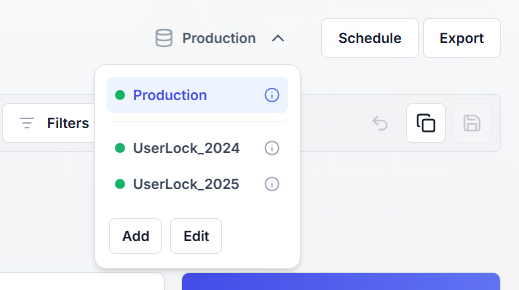
Open the database selector, to the left of the Schedule and Export buttons.
Click Add.
Complete the database wizard:
Provider: select the type of the database.
Database: enter the connection details of the existing database. See Connection details by provider.
Name: enter the name to display in the database selector, for example UserLock_2024.
Confirmation: check the summary, then click Confirm and apply.
The database is checked when you click Continue on the Database step, and again when you click Confirm and apply. If it does not exist, does not contain UserLock data, or is the production database, an error message is displayed and the archived database is not added.
The archived database appears in the database selector with its connection status. When you add it from the database selector, it is also selected automatically.
Open the report you want to generate.
Open the database selector and select the archived database. A database with a red status cannot be selected.
Set the time range of the report between the First activity and Last activity dates of the archived database, shown when you hover over the information icon next to it in the database selector, or in the Archived databases drawer. With a relative time range, such as Last 7 days, the report may be empty.
The report is generated from the archived database. The selector turns dark and shows the name of the selected database.
The selection applies to all report pages. It stays active until you select Production in the database selector.
When you export the report, the file is generated from the selected archived database.
⚠️ Important
Scheduled reports always run on the production database, whatever database is selected. To keep a report generated from an archived database, export it.
Open any report page.
Open the database selector and click Edit.
The Archived databases drawer lists your archived databases.
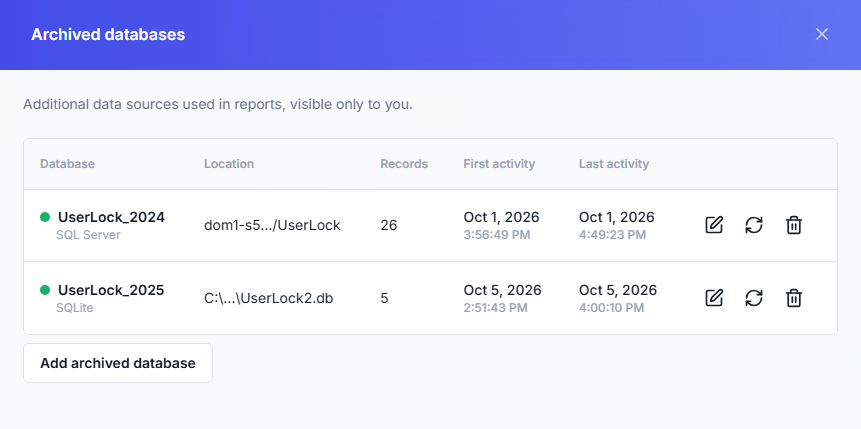
From the drawer, you can:
Change the settings of an archived database: click the pencil icon.
Test the connection again and update Records, First activity, and Last activity: click the circular arrows icon.
Remove an archived database from the list: click the trash icon, then confirm. The database itself is not deleted. If this database is selected, reports switch back to the production database.
Add another archived database: click Add archived database.
Note
Archived databases are visible only to the administrator who adds them. To use the same archived database, each administrator must add it.
When the connection check fails, an archived database shows a red status in the database selector. For the meaning of each status, see Reporting.
The problem appears in two places:
In the database selector: the database is grayed out and cannot be selected.
On the report page, if the database was selected when it became unreachable: an error message replaces the report, and two actions are available. Refresh retries the connection. Switch back to the production database selects the production database again.
To find the cause:
In the database selector, hover over the information icon of the database. It shows the date of the last connection check and the error reason.
On the report page, read the status code and details in the error message, for example a database file that cannot be opened.
To fix the connection:
Open the database selector and click Edit.
In the Archived databases drawer, click the pencil icon next to the database and correct the connection settings, for example the path of the database file on the UserLock server.
Click the circular arrows icon to test the connection again.
The connection is also tested again once when a report fails on the database, and each time you open the database selector while the database is in error. When the database is reachable again, the report reloads automatically.